
The Fourfold State of Human Nature: Entire Depravity (State 2)
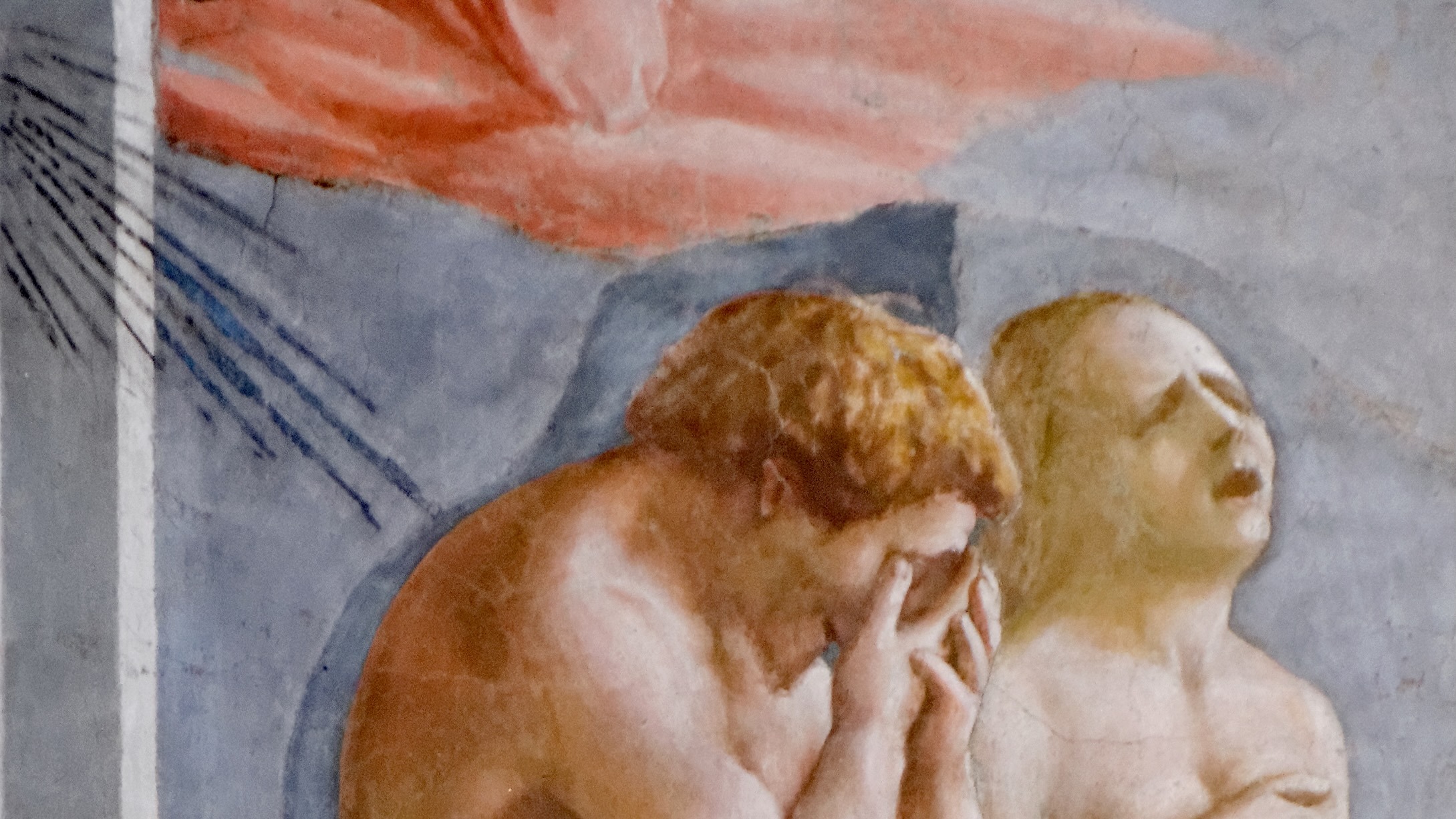
Photo Credit: Detail of Expulsion from the Garden of Eden by Masaccio Cappella Brancacci (1401-1428); from Wikimedia Commons, {{PD-US}}.
Disclosure: This post may contain affiliate links, meaning Beautiful Christian Life LLC may get a commission if you decide to make a purchase through its links, at no cost to you.
Editor’s note: This is part two of a four-part series introducing Scottish theologian Thomas Boston’s book, The Fourfold State of Human Nature. (Click here to read part one on the state of innocence and here to read part three on the state of grace.)
Thomas Boston (1676-1732) was a minister and theologian in the Church of Scotland, whose preaching and writings continue to encourage Christians around the world to this day. His book, Human Nature in Its Fourfold State, was second in popularity only to the Bible in Scotland in the eighteenth century. Such an influential book should not be overlooked by Christians today, as Boston has much to teach us about God’s redemptive plan from Genesis to Revelation.
The book is divided into four main parts, covering creation, the fall of man, redemption in Christ, and the consummation of the kingdom of God. Boston writes,
There are four things very necessary to be known by all that would see Heaven: First, What Man was in the state of innocence, as GOD made him. Secondly, What he is in the state of corrupt nature, as he hath unmade himself. Thirdly, What he must be in the state of grace, as created in Christ Jesus unto good works, if ever he be made a partaker of the inheritance of the saints in light And, Lastly, What he shall be in his eternal state, as made by the Judge of all, either perfectly happy, or compleatly miserable, and that forever. These are weighty points, that touch the vitals of practical godliness, from which most men, and even many professors, in these dregs of time, are quite estranged. I design therefore, under the divine conduct, to open up these things, and apply them.[1]
Here is a brief introduction of the second state of man, entire depravity, in Boston’s own words. All quotations are from the uncopyrighted version in the University of Michigan Digital Collection (readers can also purchase the book online or access the book for free at Christianebooks.com):
The State of Nature; or, Entire Depravity:
After Adam ate the forbidden fruit, his nature was corrupted.
We have seen what man was, as God made him, a lovely and happy creature: let us view him now as he hath unmade himself: and we shall see him a sinful and miserable creature. This is the sad state we were brought into by the fall: a state black and doleful as the former was glorious; and this we commonly call The state of nature, or Man’s natural state, according to that of the apostle, Eph ii. 2. (p. 31)
Adam was no longer holy and righteous but instead sinful and miserable.
God made a holy and righteous creature: but fallen Adam begat a son, not in the likeness of God, but in his own likeness; that is, corrupt sinful Adam begat a corrupt sinful son. For as the image of God bore righteousness and immortality in it, as was cleared before, so this image of fallen Adam bore corruption and death in it, 1 Cor. xv. 49 50. (p. 35)
The corruption of man’s nature necessitates human laws to impede the effects of sin on society.
Consider the necessity of human laws, fenced with terrors and severities; to which we may apply what the apostle says, 1 Tim. i. 9. That the law is not made for a righteous man, but for the lawless and disobedient, for the ungodly and for sinners, &c. (p. 39)
Humans try to hide their sinful thoughts and doings from the Lord, like Adam did when he hid from God in the garden of Eden.
Do not Adam‘s children naturally follow his footsteps, in hiding themselves from the presence of the LORD, Gen. iii. 8. We are every whit as blind in this matter as he was, who thought to hide himself from the presence of God among the shady trees of the garden. We are very apt to promise ourselves more security in a secret sin, than in one that is openly committed. The eye of the adulterer waiteth for the twilight, saying, No eye shall see me, Job xxiv. 15. And men will freely do that in secret, which they would be ashamed to do in the presence of a child; as if darkness could hide from an all-seeing God. (p. 44)
Whereas man’s mind was a lamp of light, without regeneration it is buried in darkness.
Man’s understanding is naturally overwhelmed with gross darkness in spiritual things. Man, at the instigation of the devil, attempting to break out a new light in his mind, (Gen. iii. 5.) instead of that, broke up the doors of the bottomless pit: so, as by the smoak thereof, he was buried in darkness. When God at first had made man, his mind was a lamp of light: but now when he comes to make him over again in regeneration, he finds it darkness, Eph. v. 8.
The hearts of fallen humans are plagued by corrupt imaginations.
Consider how the carnal imagination supplies the want of real objects to the corrupt heart; that it may make sinners happy, at least, in the imaginary enjoyment of their lusts. Thus the corrupt heart feeds itself with imagination-sins: the unclean person is filled with speculative impurities, having eyes full of adultery; the covet|ous man fills his heart with the world, tho’ he cannot get his hands full of it; the malicious person, with delight, acts his revenge within his own breast) the envious man, within his own narrow soul, beholds, with satisfaction, his neighbour laid low enough; and every lust finds the corrupt imagination a friend to it in time of need. (p. 53)
Fallen humans outside of Christ have little to no concern that they are children of wrath (Eph. 2:3).
Many live as they were born, and are like to die as they live, and yet live in peace. Do such believe the sinfulness and misery of a natural state? Do they believe they are children of wrath? Do they believe there is no salvation without regeneration? And no regeneration but what makes man a new creature? If you believe the promises of the word, why do you not embrace them, and labour to enter into the promised rest? (p. 56)
The natural man’s will is under bondage to sin and is accordingly adverse to good.
There is in the unrenewed will an averseness to good. Sin is the natural man’s element; he is loath to part with it, as the fishes are to come out of the water into dry land. He not only cannot come to Christ, but he will not come, John v. 40. He is polluted, and hates to be washen, Jer. xiii. 27 Wilt thou not be made clean? When shall it once be? He is sick, but utterly averse to the remedy: he loves his disease so, that he loathes the Physician. (p. 60)
Adam was the federal representative of mankind, and his sin corrupted not only himself but also all of his posterity.
By his sin [Adam] stript himself of his original righteousness, and corrupted himself: we were in him representatively, being represented by him, as our moral head, in the covenant of works; we were in him seminally, as our natural head; hence we fell in him, and by his disobedience, were made sinners, as Levi, in the loins of Abraham paid tithes, Heb. vii. 9, 10. (p. 82)
Adam and Eve broke all ten commandments when they ate the fruit that God forbid them to eat.
Let none wonder that such an horrible change would be brought on by one sin of our first parents, for thereby they turned away from God, as their chief end, which necessarily infers an universal depravation. Their sin was a complication of evils, a total apostasy from God, a violation of the whole law. By it they broke all the ten commands at once. (1.) They chose new gods. They made their belly their god, by their sensuality: self their god, by their ambition; yea, and the devil their god, believing him, and disbelieving their Maker. (p. 83)
Those outside of Christ, the children of wrath, shall be removed from God’s presence forever.
They shall be eternally shut up in hell, never to get the least drop of comfort, nor the least ease of their torment. There they will be punished with the punishment of loss: being excommunicated for ever from the presence of God, his angels and saints. All means of grace, all hopes of a delivery, shall be for ever cut off from their eyes. They shall not have a drop of water to cool their tongues, Luke xvi. 24, 25. They shall be punished with the punishment of sense. They must not only depart from God; but depart into fire, into everlasting fire. There the worm, that shall gnaw them, shall never die; the fire, that shall scorch them, shall never be quenched. God shall, thro’ all eternity, hold them up with the one hand, and pour the full vials of wrath into them with the other. (pp. 101-102)
Unbelievers must with all urgency flee out of the kingdom of darkness and into the kingdom of God.
Then it is impossible for us to be saved. Answer, It is so, while you are in that state. But if you would be out of that dreadful condition, hasten out of that state. If a murderer be under sentence of death, so long as he lives within the kingdom, the laws will reach his life; but if he can make his escape, and get over the sea, into the dominions of another prince, our laws cannot reach him there. This is what we would have you to do: flee out of the kingdom of darkness, into the kingdom of God’s dear Son; out of the dominion of the law, into the dominion of grace; then all the curses of the law, or covenant of works, shall never be able to reach you. (p. 111)
Believers should humbly remember their former state of misery and rejoice that they are now, by grace alone, heirs of God in Christ.
Remember there was nothing in you to engage him to love you, in the day he first appeared for your deliverance Ye were children of wrath, even as others, fit for hell, and altogether unfit for heaven: yet the King brought you into the palace: the King’s Son made love to you a condemned criminal, and espoused you to himself, on the day in which ye might have had been led forth to execution. Even so, Father, for so it seemeth good in the sight, Matth ix. 26. (p. 115)
May unbelievers humble themselves before the Lord and recognize that delivery from God’s wrath comes only from God in Christ.
O be convinced of thy absolute need of Christ, and his overcoming grace; believe thy utter inability to recover thyself: and so thou mayst be humbled, shaken out of thy self-confidence, and ly down in dust and ashes, groaning out thy miserable case before the Lord: A kindly sense of thy natural impotency, the impotency of depraved human nature, would be a step towards a delivery. (p. 128)
Readers can purchase Boston’s The Fourfold State of Human Nature online or access the book for free at Christianebooks.com)
Related Articles:
- The Fourfold State of Human Nature: Innocence (State 1)
- The Fourfold State of Human Nature: Grace (State 3)
- Two Gardens, Two Adams, and the Forgiveness of Your Sins
- Who Is Representing You—Adam or Jesus?
- 6 Reasons Why Adam and Eve’s Eating of the Forbidden Fruit Was a Terrible Transgression against God
- How Do People Try to Cover Up Their Sins with Fig Leaves Like Adam and Eve Did?
Notes:
[1] All quotations from Thomas Boston’s Human Nature in Its Fourfold State are sourced from the University of Michigan Digital Collection; some minor updates in spelling have been made to modernize the text from the original version.
- About the Author
- Latest Posts

